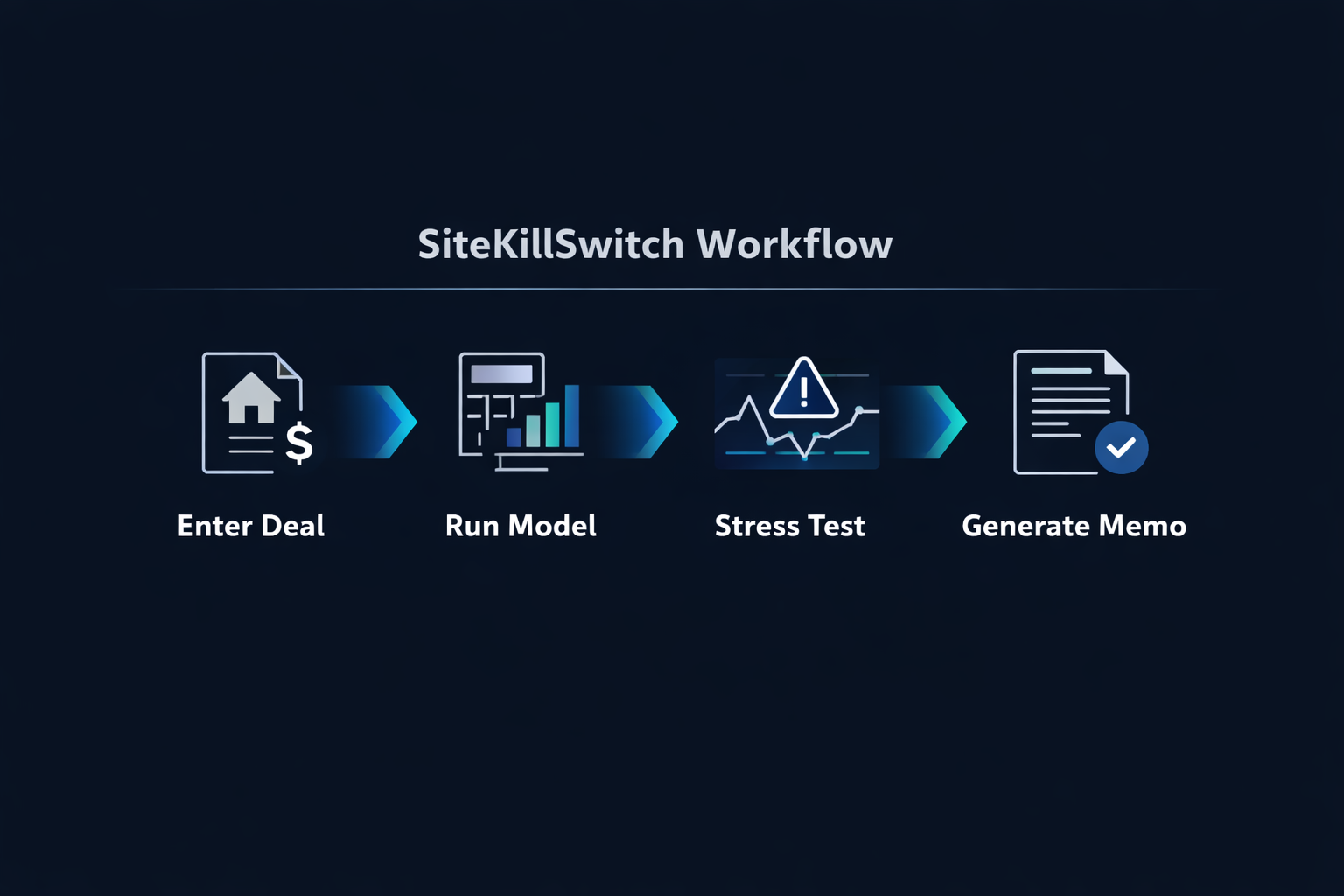
How SiteKillSwitch Works
A structured way to screen small development opportunities before committing serious time, consultant fees, or capital.
A practical workflow for early development decisions
Most development opportunities are evaluated with rough spreadsheets, scattered notes, or instinct.
SiteKillSwitch replaces that with a structured screening workflow designed for small multifamily and infill projects. The system quickly evaluates project assumptions, generates financial outputs, stress-tests key variables, and organizes the results into a clear underwriting memo.
The goal is simple: identify strong opportunities earlier and eliminate weak ones before they consume time and money.
1. Enter the basic project assumptions
Every analysis begins with a small set of practical inputs about the opportunity.
These typically include the property address, expected unit count, purchase price, and high-level cost and revenue assumptions. The goal is not perfect precision at this stage, but a disciplined first-pass model that reflects realistic development economics.
Because the inputs are intentionally simple, most opportunities can be screened in just a few minutes.
2. The system runs the underwriting model
Once the project assumptions are entered, SiteKillSwitch calculates the core development economics.
The system estimates total project cost, expected revenue, break-even values, and projected returns. This includes metrics such as margin, profit-on-cost, equity required, and capital structure.
The output provides a clear snapshot of whether the opportunity appears viable based on the current assumptions.
3. Scenario analysis stress-tests the deal
Development projects rarely behave exactly as expected.
SiteKillSwitch automatically compares multiple scenarios to show how the project performs under different conditions. This includes downside, base, and optimized outcomes so you can see how sensitive the project is to changes in pricing, costs, or timing.
This step helps reveal whether a deal has genuine buffer or whether it only works under optimistic assumptions.
4. A structured underwriting memo is generated
Once the analysis is complete, SiteKillSwitch organizes the results into a structured Underwriting Memo™.
The memo summarizes the deal snapshot, financial outputs, capital requirements, scenario analysis, and key risk drivers. It also generates a diligence checklist identifying the assumptions that still need to be verified before moving forward.
Instead of scattered notes or multiple spreadsheets, you end up with a clear decision document for the opportunity.
WHY THIS PROCESS WORKS
Screen deals earlier
Most weak development opportunities fail because the economics were never examined carefully enough at the beginning.
By running a structured screen early in the process, SiteKillSwitch helps developers focus their time and attention on the opportunities that actually deserve deeper work.
That means fewer weeks spent analyzing deals that ultimately do not make sense.
WHO USES THIS WORKFLOW
SiteKillSwitch is designed for people evaluating real development opportunities, including:
• Small multifamily developers
• Builders assessing infill sites
• Investors evaluating development land
• Professionals screening opportunities before deeper diligence begins
The workflow is particularly useful during the earliest stages of a project when decisions must be made quickly but with reasonable discipline.
Try the underwriting workflow
Run a real opportunity through the SiteKillSwitch workflow and see how the system evaluates the project